‘I’ am here! The necessity of acknowledging the historian in scholarship
Written by Amber Zijlma
Positionality and bias are interconnected. In this series of blog posts, we share our thoughts on positionality by reflecting on experiences we’ve had with it in our own work.
As a history student at a British university, I was discouraged from including the personal pronoun ‘I’ in my essays. Instead, a more impersonal ‘we’, or more preferably ‘this essay’, were to be used. This seems to be the general rule of thumb for (English) academic writing, inferred from the many writing guides titled something along the lines of ‘Using personal pronouns in writing’.1 University writing guides agree that the ‘I’ is recommended only when the assignment is reflexive or when a personal experience is explicitly relevant to the piece of writing.
While it is very valid that the ‘I’ sometimes just makes sentences more complicated and less easy to read, I think much of the reasoning for avoiding this personal pronoun is to present some form of objectivity to a paper. Objectivity is then associated with authority, believability, and legitimacy within academia. Some writing guides touch on this point that the ‘I’ highlights the author’s position within the research - and that this is not always wanted or necessary.
My point here is, however, that the author’s position - the ‘I’ - is always relevant.2 Subjectivity is inherent to writing, researching, and just existing, really. Not being able to acknowledge an author’s positionality, their identity and context and narrative, means feigning objectivity (an ‘unbiased’ history) that doesn’t exist. And this is a much bigger issue that goes beyond whether or not the use of ‘I’ is ‘good academic practice’.
I find it quite ironic, because historians are acutely aware of the significance of positionality. We spend much of our research time on critically analysing the significance of the author’s background of (primary) sources, so to understand in what way we should read the source itself. Expressing our own identities, however, is heavily discouraged, whether it is through the use of ‘I’ or personal anecdotes in our writing.
Admittedly, I too believed for a long time that my writing had to be as impersonal as I could make it. That was until I was writing up a blog post for an internship I was doing, and my internship supervisor prompted me to specifically include why I chose to write about the topic I had researched. The project3 I was a part of conducted research into World War II photographs of Jewish people in the Netherlands, and I had come across a photograph taken in my hometown, Apeldoorn. It was taken in an area I had passed many times, without ever being aware of the history behind it - I felt ashamed for my unknowing, and this drove me to write something about this history. Acknowledging my presence in the narrative, made the writing more immediate, urgent, and transparent.4
This adds to what my internship supervisor told me: that much of the history writing on resistances is grounded in activism, writers overtly merging their identities as historians and activists, often not out of sole interest but necessity.5 There is therefore power in this self-reflection in research: not only does it show self-awareness to the reader; it can also strengthen the research, because the author’s identity adds their lived experiences to their writing, providing depth and perspective.
This is especially important, because history itself is a collection of multiple perspectives and interpretations of the past, sometimes contradictory, that exist alongside each other.6 The reluctance to present a historical narrative in a way that acknowledges the human nature of its writing, is therefore damaging to knowledge production, as it contradicts the essence of history itself: a plurivocal narrative of the past. And so, these perspectives need to be clearly laid out to be able to facilitate transparent discussions about history.
I think including the ‘I’ is one way to openly acknowledge biases that are present in an author’s positionality. There is power in this recognition, as well as value in enabling transparent discussion. History writing, after all, is inherently subjective, and consequently, history itself consists of (opposing) narratives and experiences. Understanding the human nature of this is crucial - only then can we properly reflect on biases present in historical research and navigate them effectively.
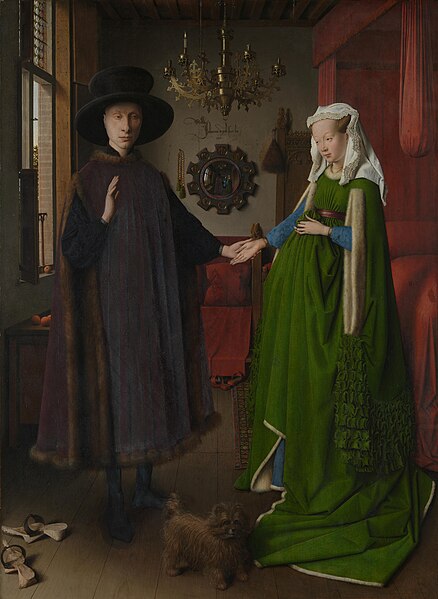

Figures 1 and 2: I am here! Left: Jan van Eyck, The Arnolfini Portrait (1434). Inscription above the mirror: Johannes de Eyck fuit hic. 1434 (Jan van Eyck was here. 1434). Right: Street view in reflection, Busan, South Korea (2024). At the bottom of the mirror, you can see me take the photograph.
Bibliography and further reading
UCB Writing Centre. “How to Avoid Using First Person Point of View in Academic Writing,” 2013. https://blogs.ubc.ca/writingcentre/files/2013/01/Tutor-project-Avoid-First-Person-POV.pdf.
Centre for Learning & Teaching, University of Aberdeen. “Academic Writing: Use of the First Person,” n.d. https://www.abdn.ac.uk/medical/humanities/pluginfile.php/72/mod_resource/content/1/Use%20the%20first%20person.pdf.
The Writing Center, University of North Carolina at Chapel Hill. “Should I Use ‘I’?”. https://writingcenter.unc.edu/tips-and-tools/should-i-use-i/.
Williams, Bronwyn T. “Pay Attention to the Man Behind the Curtain: The Importance of Identity in Academic Writing.” Journal of Adolescent & Adult Literacy 49, no. 8 (2006): 710–15. https://doi.org/10.1598/JAAL.49.8.7.
Duke Writing Studio. “Because I Said So: Effective Use of the First-Person Perspective and the Personal Voice in Academic Writing,” n.d. https://twp.duke.edu/sites/twp.duke.edu/files/file-attachments/first-person.original.pdf.
Berger, Stefan, ed. The Engaged Historian: Perspectives on the Intersections of Politics, Activism and the Historical Profession. 1st ed. Vol. 37. Berghahn Books, 2019. https://doi.org/10.2307/j.ctv287sg3g.
Stryker, Susan. Transgender History. Seal Studies. Berkeley, Calif: Seal Press, 2008.
Jeurgens, Charles, and Michael Karabinos. “Paradoxes of Curating Colonial Memory.” Archival Science 20, no. 3 (September 1, 2020): 199–220. https://doi.org/10.1007/s10502-020-09334-z.
Basaraba, Nicole, and Thomas Cauvin. “Public History and Transmedia Storytelling for Conflicting Narratives.” Rethinking History 27, no. 2 (April 3, 2023): 221–47. https://doi.org/10.1080/13642529.2023.2184969.
-
See for example: UCB Writing Centre. “How to Avoid Using First Person Point of View in Academic Writing” 2013; Centre for Learning & Teaching, University of Aberdeen. “Academic Writing: Use of the First Person”; The Writing Center, University of North Carolina at Chapel Hill. “Should I Use ‘I’?”. For a nuanced reading, look at Duke Writing Studio. “Because I Said So: Effective Use of the First-Person Perspective and the Personal Voice in Academic Writing”. ↩
-
Bronwyn Williams (2006) makes the same point: “If we admit that there are different ways of creating knowledge, then we must also acknowledge that such differences can be influenced by the culture around us. Once we find ourselves thinking about culture we are also thinking about identity.” The broader argument is the detrimental effects of not allowing students to include their identities (and passions and curiosities) in their education. ↩
-
NIOD ImageLab Behind the Start project: https://www.niodimagelab.nl/ ↩
-
Find the written article here: https://www.niodimagelab.nl/apeldoornsche-bosch ↩
-
See for example: Stefan Berger (2019). For specifically transgender histories and activism, see for example: Susan Stryker (2008). ↩
-
See for example, Charles Jeurgens and Michael Karabinos (2020) and Nicole Basaraba and Thomas Cauvin (2023). ↩